May 21, 2026
PIM System Implementation: How to Successfully Implement it in Your Company
Product data scattered everywhere? Here's how to successfully implement a PIM system – from data strategy to operations.

Product data in Excel, master item data in the ERP, marketing texts on a shared drive – and in the end, no one knows which version is current. This scenario is commonplace in many companies, even as portfolios grow and channel requirements increase. The result: erroneous product data in the webshop, delayed market launches, and rising internal coordination costs.
The implementation of a PIM system solves exactly this problem – provided the project is set up correctly. This article shows what truly matters: from data strategy through system selection to productive operation.
Key takeaways at a glance:
- A PIM implementation is not purely an IT project, but an organizational transformation project
- The data strategy and data model must be defined before system selection
- Integration into existing system landscapes (ERP, DAM, e-commerce) is critical for success
- Change management and user acceptance determine long-term project success
- An agile methodology with clearly prioritized use cases delivers fast, measurable results
What is a PIM system and why is it indispensable today?
A Product Information Management system, or PIM for short, is a central software solution for managing, enriching, and distributing product information. It consolidates all product-relevant data in one place: technical specifications, marketing texts, images, classifications, translations, and channel-specific variants.
The difference from an ERP system lies in its focus: while ERP primarily maps business processes and transactional data, a PIM system is geared towards the quality, completeness, and syndication of product data. Both systems complement each other but do not replace each other.
Why the demand for PIM solutions is increasing:
Product data requirements are increasing on several fronts at once. Retail partners like Amazon, Otto, or Zalando demand standardized, high-quality data formats. Regulatory requirements such as the Digital Product Passport (DPP) necessitate comprehensive product documentation. And AI-powered processes in marketing and sales require a structured, machine-readable data foundation.
When is implementing a PIM system beneficial?
Not every company immediately needs a comprehensive PIM system. However, there are clear indicators that point to an urgent need for action:
- The product portfolio includes more than 500 actively managed products
- Product data is delivered to more than two output channels (e.g., webshop, print, marketplaces)
- Multiple languages or markets need to be served
- Data quality is inconsistent and leads to internal coordination efforts
- Time-to-market for new products exceeds acceptable limits
- An ERP rollout or an e-commerce migration is imminent
The five phases of a successful PIM implementation
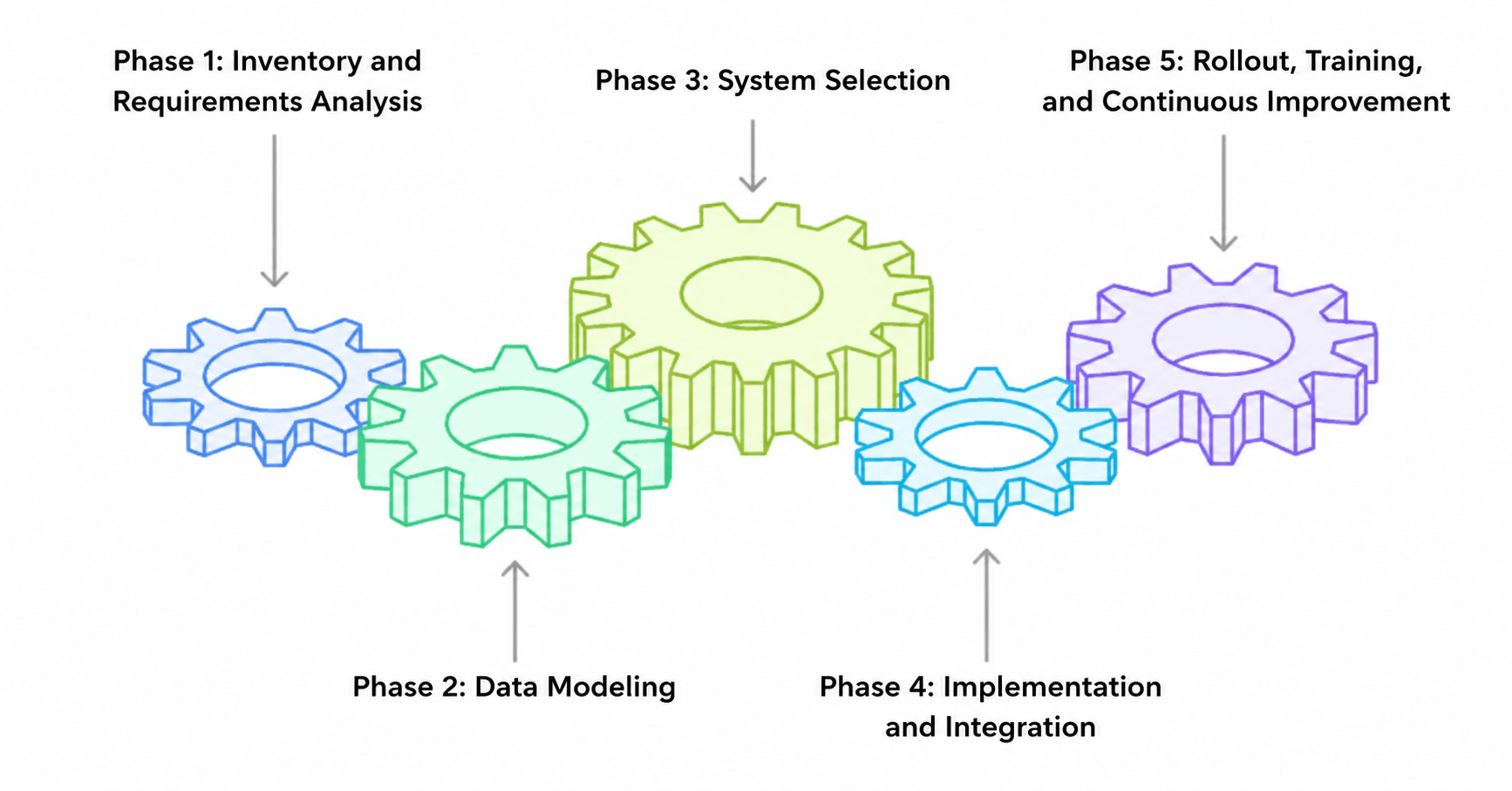
Phase 1: Discovery and Requirements Analysis
Prior to system selection, a structured analysis of the current state is crucial. What data sources exist? Who maintains which data in which system? Which output channels need to be served? What data quality issues are known?
A Data Maturity Assessment provides an objective foundation. It shows how mature the existing data foundation is and where the greatest need for action lies – before a single system is evaluated.
Phase 2: Data Modeling
The Data Model is the core of any PIM implementation. It defines how product data is structured, classified, and managed – and thus determines how flexibly the system can respond to new requirements.
Typical errors in this phase: overly rigid classification structures, missing multilingual logic, insufficient consideration of trading partner specifications (GS1, ETIM, BMEcat). A well-conceived data model pays off for years to come.
Phase 3: System Selection
Based on the defined requirements, suitable PIM solutions are evaluated. Relevant providers in the enterprise segment include Syndigo, Akeneo, Contentserv, and Stibo Systems – each solution with specific strengths regarding industry, integration depth, and AI functionality.
System selection should be based on a structured RFP process with weighted evaluation criteria – not solely on demos and marketing materials.
Phase 4: Implementation and Integration
Technical implementation includes system configuration, data migration from existing sources, and integration into the surrounding system landscape. Typical interfaces include ERP systems (SAP, Microsoft Dynamics), DAM systems, e-commerce platforms (Shopify, Salesforce Commerce Cloud), and marketplace connectors.
Agile Project Methodology – such as Scrum or SAFe – has proven effective here. It allows for early activation of initial sub-areas and continuous incorporation of feedback, rather than delivering a complete system only after months.
Phase 5: Rollout, Training, and Continuous Improvement
Technical commissioning is not the end of the project – it's the beginning of productive operation. User acceptance is created through targeted training, clear governance structures, and well-conceived role assignments within the system. Those who cut corners in this phase risk the PIM system becoming an unused investment.
What does a PIM system implementation cost?
There is no blanket answer – the total costs depend on portfolio size, system complexity, integration scope, and migration effort. Roughly, three cost areas can be distinguished:
License and SaaS costs vary significantly depending on the provider, number of users, and scope of functions. Cloud-native solutions often offer greater planning certainty through monthly or annual subscription models.
Implementation costs include project management, data modeling, migration, integration, and training. Experience shows that these costs often exceed the pure licensing fees – especially if the data foundation needs to be cleaned up before migration.
Ongoing operating costs for maintenance, support, and continuous development should be factored in from the start.
The ROI of a PIM system is realized on multiple levels simultaneously: shorter time-to-market, reduced manual maintenance effort, fewer returns due to data errors, and higher conversion rates through consistent product data. In practice, well-implemented PIM projects typically pay for themselves within twelve to 36 months – depending on how significantly the initial situation is characterized by inefficient data processes.
Common Mistakes in PIM Implementation
Many PIM projects fail not due to technology, but due to avoidable organizational and strategic errors:
Lack of Data Strategy Before System Selection: The system is chosen before it's clear what data it should manage – with the consequence that the data model is subsequently adapted to the system instead of the other way around.
Underestimated Migration Effort: Cleaning and migrating existing data is usually more complex than anticipated. Poor data quality in the initial dataset is one of the most common causes of project delays.
Insufficient Involvement of Business Departments: PIM is not an IT project. Marketing, sales, product management, and e-commerce must be involved from the outset – not just as stakeholders, but as active contributors.
Overly Ambitious Scope in the First Release: Attempting to implement all requirements in a single project leads to long durations and diminishing momentum. A prioritized, phased rollout is almost always preferable.
PIM in the Context of Modern System Architectures

Modern PIM systems are not isolated solutions. They are part of an integrated digital supply chain, ranging from raw data onboarding and enrichment to syndication across all relevant channels.
Headless architectures and API-first approaches enable flexible integration with e-commerce platforms, marketplaces, and print publishing systems. Cloud-native PIM solutions offer advantages in terms of scalability, maintainability, and the integration of AI functionalities such as automated data enrichment, AI-powered translation or intelligent data validation.
Advellence: PIM Implementation Leveraging Project Experience
A typical real-world scenario: A retail company plans to migrate to a new e-commerce platform and discovers during preparation that product data is maintained in four different systems, classification structures are missing, and translations are coordinated manually via email. The actual e-commerce project can only begin once the data foundation is consolidated.
This is precisely where Advellence comes in. The starting point is never the system itself, but rather an analysis of the actual data processes, system landscape, and strategic goals. This leads to a prioritized project plan that sets realistic milestones and delivers measurable results early on.
Advellence supports companies in Retail, Consumer Goods Industry, Mechanical and Plant Engineering as well as the Healthcare sector – from requirements analysis and system selection to ongoing operations. Collaboration with leading PIM providers like Syndigo, along with certifications in agile methodologies and relevant ISO standards, ensures quality and investment security.
Best Practices for a Successful PIM Implementation
- Data Strategy First: Define goals, data domains, and governance rules before system selection begins
- Design a future-proof data model: Plan for flexibility for new markets, languages, and product categories
- Take an agile approach: Implement prioritized use cases incrementally and deploy them early
- Consider integration from the outset: Design ERP, DAM, and e-commerce integration early
- Establish governance: Clear responsibilities for data maintenance, quality assurance, and approval processes
- Involve users: Training and Change Management as an integral part of the project
FAQ: Frequently Asked Questions about PIM Implementation
What is the most common reason why PIM projects fail?
A missing data strategy before project start and insufficient involvement of specialist departments. Anyone who selects the system before the data model and governance structures are defined is building on an unstable foundation.
Do I need a PIM system if I already have an ERP?
ERP and PIM serve different purposes. ERP manages transactional data, while PIM optimizes product content for marketing, sales, and channel communication. In practice, both systems complement each other – neither replaces the other.
What is the difference between PIM and DAM?
PIM manages structured product information such as texts and attributes. DAM manages digital media files like images and videos. Modern architectures link both systems bidirectionally.
When does a cloud-native PIM make more sense than on-premise?
Cloud-native PIM solutions are preferable in most cases today – they are more scalable, require less maintenance, and offer native AI functionalities. On-premise is only worthwhile for very specific security or compliance requirements.
How does the Digital Product Passport influence the requirements for a PIM system?
The Digital Product Passport requires seamless, machine-readable product documentation along the entire supply chain. PIM systems must support structured data management, clear proof of origin, and standardized export formats – an aspect that absolutely must be considered when selecting a system today.
How do I choose the right PIM system?
Based on a structured requirements catalog – not just on demos alone. Key factors are integration depth, industry fit, AI functionality, and the quality of the implementation partner.
Strategic Advisory & Effective Execution
We continuously innovate to transform data into competitive advantage via expert advisory, effective project execution, and precision engineering.
.svg)
Our Blog for Experts.
We use our expertise in various disciplines to turn data into sustainable competitive advantages for our customers and to share our knowledge.



Further News
All the latest news about Advellence